

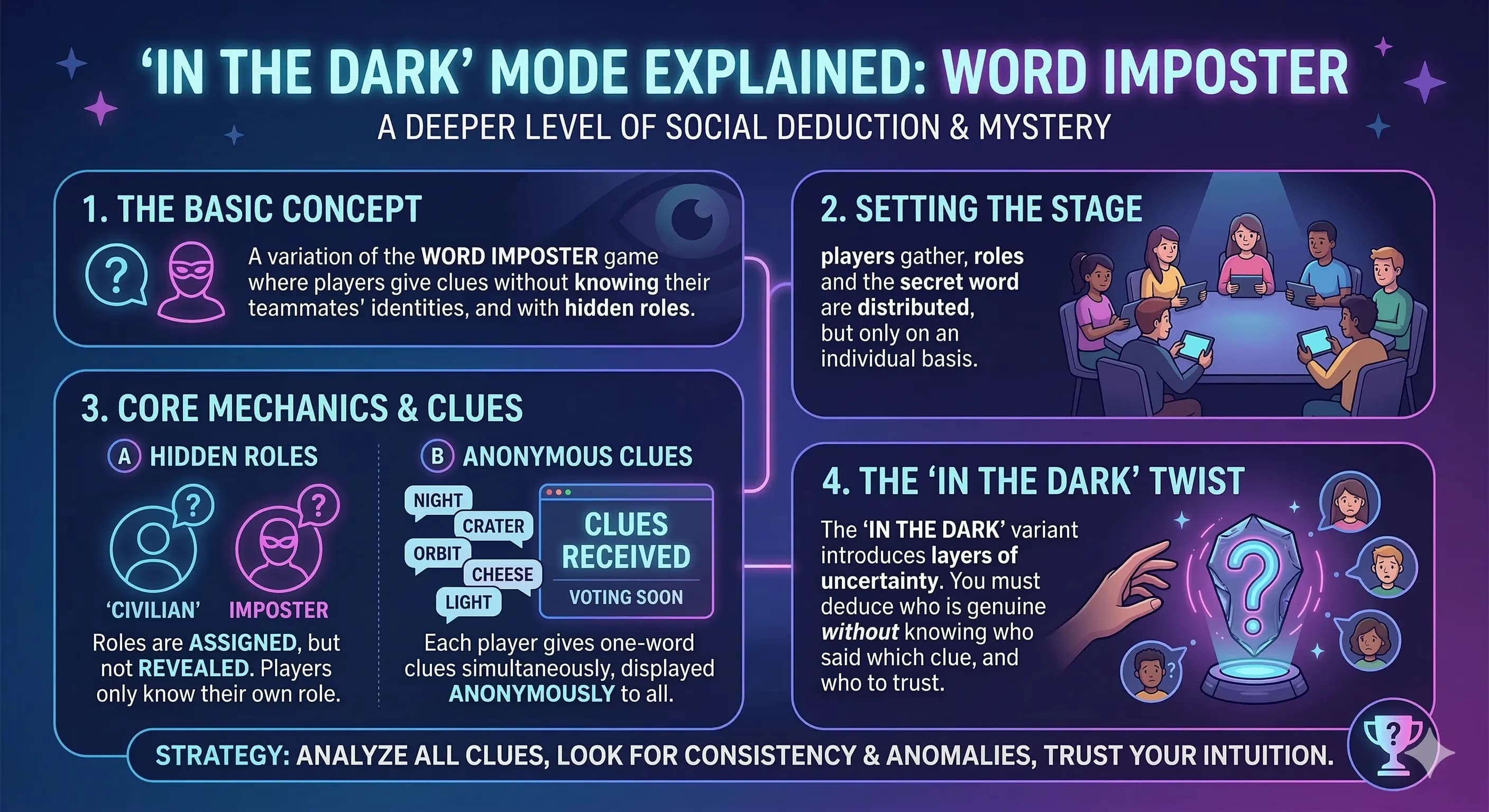

You've played Classic mode. You know the feeling: you flip your card, see the impostor icon, and immediately start sweating through your convincingly casual demeanor. Classic is stressful in a fun way. "In the Dark" mode is a different beast entirely. And it's arguably the best thing about Word Impostor.
What "In the Dark" Actually Does
In Classic mode, the impostor gets a red card that clearly tells them they're the impostor and they don't know the word. In "In the Dark" mode, every player gets a card that looks like a normal civilian card — complete with a word on it. The difference is that the impostor's word is fake. It's a plausible-sounding word in the same general category, but it is not the real secret word that all the civilians have.
So in Classic mode, the impostor knows they're the impostor from the moment the game starts. In "In the Dark" mode, the impostor thinks they're a civilian. They start giving clues about their (fake) word. And then, as more clues come in from other players, something starts feeling off. Their word doesn't quite fit what others are hinting at. That's the moment of realization — and it hits differently every time.
Why This Changes Everything
In Classic mode, the impostor has one job: survive socially. They have no information, but they know they have no information, so they can strategize around that constraint from the start.
In "In the Dark" mode, the impostor has confidently wrong information. They're not playing cautiously — they're playing as a genuine civilian who happens to have the wrong word. The early game looks completely different: the impostor gives legitimate-sounding clues about their fake word, often with more confidence than they'd have in Classic mode because they don't know yet that something is wrong.
This has two fascinating effects. First, it makes the impostor harder to catch early — their initial clues sound confident and purposeful, which is actually correct behavior for someone who believes they're a civilian. Second, it creates a specific mid-game pivot where the impostor has to switch strategies on the fly, often without making it obvious that they've changed course.
How to Win as the Civilian in "In the Dark"
As a civilian, your detection strategy changes in "In the Dark" mode. You can't look for a player who seems nervous or hesitant from the start — the impostor genuinely doesn't know they're the impostor yet. Instead, watch for the pivot. Look for the player whose clue quality shifts mid-round. Early confident clues followed by a noticeably more vague, hedge-y clue is a key tell.
Also pay attention to clues that technically fit the general theme but don't feel specific to your word. If the word is "Piano" and someone says "instrument," that works — but so does "instrument" for Guitar, Violin, Trumpet, and fifty other things. Vague clues from a confident player are suspicious in a way they wouldn't be in Classic mode.
How to Win as the Impostor
First: don't panic when you realize you're the impostor. The realization usually hits around the second or third round of clues — other players are saying things that clearly fit a word that isn't what you have. At that point, your job shifts. Stop giving clues about your fake word immediately. Pivot to more abstract, universally applicable clues that could fit either word.
Second: use your fake word as a starting point. The game designers deliberately pick fake words that are in the same general neighborhood as the real one. If your fake word is "Flute" and everyone else seems to be hinting at something with keys and hammers, you should be considering "Piano" or "Harpsichord" before you commit to a final guess.
Third: your early confidence is actually an asset, even after you realize you've been giving wrong clues. You gave those clues earnestly — and other players saw that. It softens suspicion in a way that won't happen if you start visibly floundering.
Is "In the Dark" Better Than Classic?
It depends on your group. First-time players should start with Classic mode — the mechanics are simpler and you can focus on learning the game's rhythm. Once your group has a few Classic games under your belt, switch to "In the Dark" and watch everything you knew about the game get upended in the best possible way.
Most experienced Word Impostor groups eventually prefer "In the Dark" as their default mode. The emergent stories it creates — the impostor confidently giving wrong clues for three rounds, then having to recover under everyone's growing suspicion — are uniquely memorable.
Ready to try it? Create a room, switch the game mode to In the Dark, and prepare for the most chaotic round you've ever played. If you haven't played Classic yet, start with our beginner's guide first.