

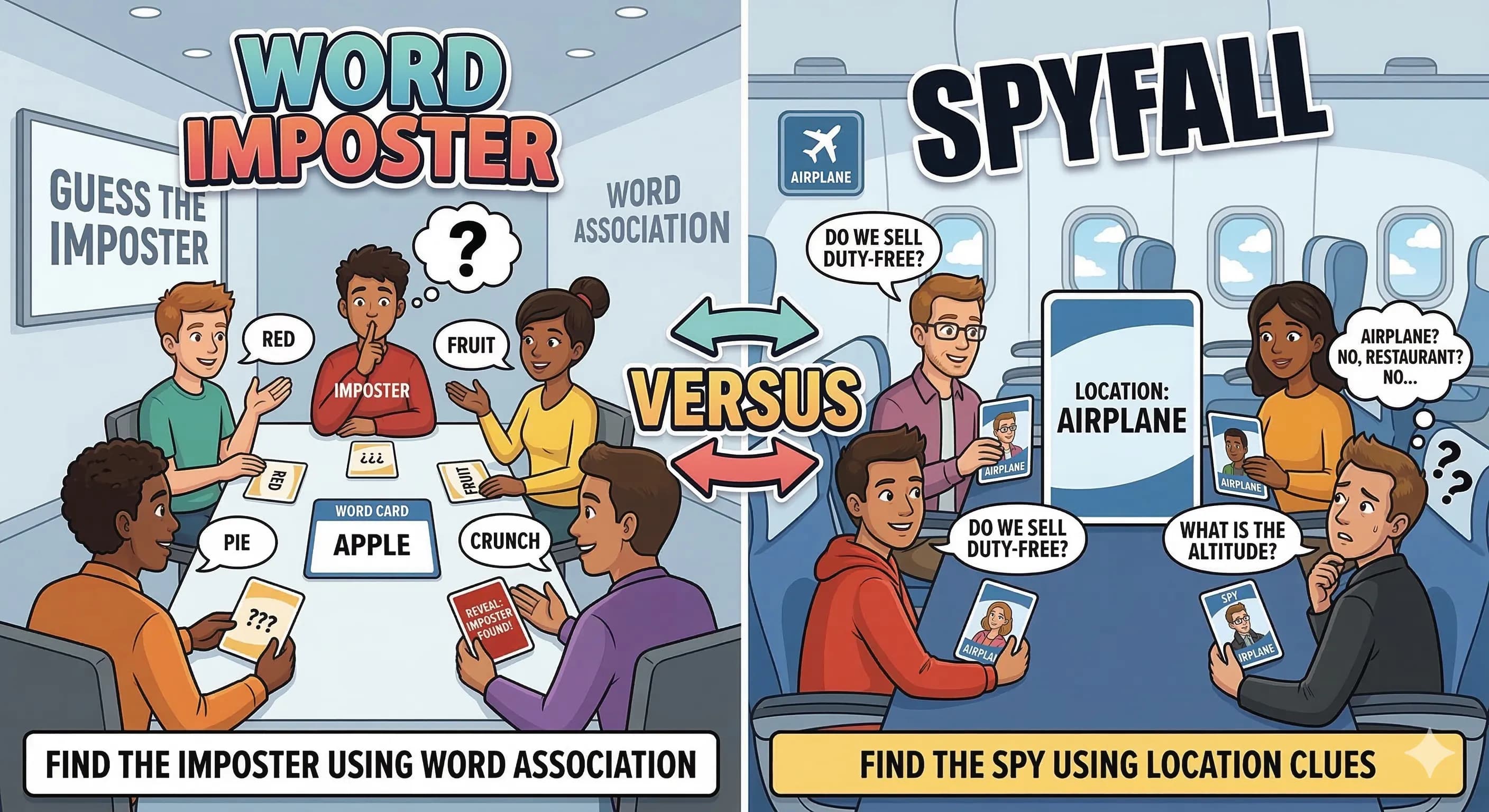

If you've been in social deduction game circles for a while, you've almost certainly played Spyfall — or at least heard it recommended a dozen times. It's a beloved game, and deservedly so. Word Impostor draws obvious inspiration from it. But calling them the same game would be like calling chess and checkers identical because they both use a board.
If you're deciding which to play for your next game night, here's everything you need to know.
The Core Similarities
Both games share the same fundamental skeleton: one player is the secret outsider who doesn't know the group's shared secret. Everyone else does. Through a structured interaction round, the group tries to expose the outsider while the outsider tries to survive long enough to either avoid being caught or correctly guess the secret at the end.
Both are best with 4–8 players. Both work great on voice calls. Both create incredible moments of paranoia, bad acting, and spontaneous laughter. And both have short enough rounds that you'll want to immediately play again.
The Key Difference: One Word vs. Full Conversation
This is where the two games diverge completely.
In Spyfall, players take turns asking each other open-ended questions about the secret location. "Would you feel comfortable bringing your children here?" "Is this somewhere you'd go on a first date?" The spy has to answer each question convincingly without knowing where "here" is. This creates long, freeform conversations full of implication and double meaning.
In Word Impostor, each player says exactly one word. That's it. No follow-up. No conversation during the clue round. Just one carefully chosen word per player, and then the discussion phase begins.
This one structural difference changes the entire feel of both games. Spyfall is conversational, theatrical, and longer. Word Impostor is surgical, tense, and snappy.
Learning Curve
Spyfall asks more of players upfront. You need social agility — the ability to ask questions that seem natural for a location you definitely know, while reading the spy's discomfort. First-time players often freeze, ask clumsy questions, or accidentally reveal the location outright.
Word Impostor's barrier to entry is much lower. Say one word. Listen to other people say words. Vote. That's the game at a surface level. The depth comes from repetition and strategy, but the first game is accessible to anyone. We've seen 60-year-old relatives get fully invested within two rounds.
Accessibility and Cost
| Feature | Word Impostor | Spyfall |
|---|---|---|
| Platform | Free browser game | Card game + paid app |
| Cost | Completely free | ~$20 physical / ~$5 app |
| Setup time | Under 1 minute | 3–5 minutes (physical) |
| Round length | 8–12 minutes | 10–20 minutes |
| "In the Dark" variant | Yes — built in | No direct equivalent |
| Works on video call | Perfectly | Works but less seamless |
Group Dynamics
Spyfall rewards groups that are naturally theatrical and enjoy conversation. If your friend group loves improv, storytelling, or debates, Spyfall's open format gives them more room to shine.
Word Impostor works better for groups that are more analytical, or for mixed groups where not everyone is comfortable performing in a freeform conversation. The structured one-word format levels the playing field — quieter players can be just as lethal as the loudest voice in the room.
Replayability
Both games have strong replayability, but for different reasons. Spyfall's replay value comes from its variety of locations (30+ in the original) and the emergent storytelling each group creates. Word Impostor's replay value comes from the shifting meta between rounds — groups develop in-jokes, patterns, and tells that make each session deeper than the last.
Which Should You Play?
Choose Word Impostor if: you want something free, fast, and playable right now across any device; your group has mixed experience levels; you like tight, strategic deduction over open-ended conversation.
Choose Spyfall if: your group loves long theatrical conversations; you enjoy physical card games; you want a wider variety of built-in locations and roles.
Honestly? Play both. They're different enough that one won't replace the other. Many groups use Word Impostor for quick rounds early in the night and pull out Spyfall when they want something longer and more immersive.
Ready to try Word Impostor for yourself? Create a free room right now. No download, no account — just send the link and play.
If you're new to the game, check out our complete beginner's guide first, then come back and run 10 rounds with your friends.