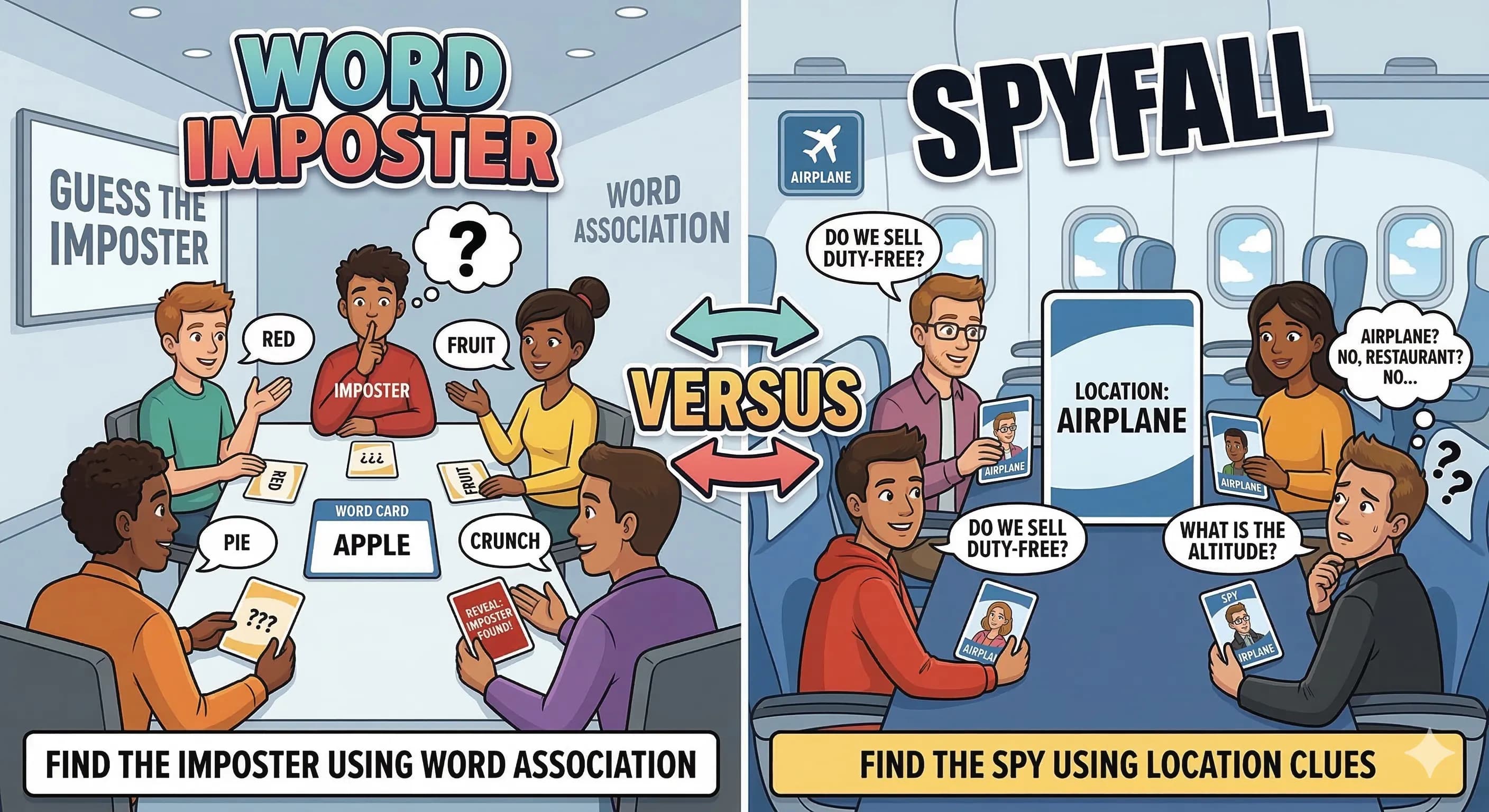



If you've played one, someone has probably recommended the other. Word Impostor and Codenames are both beloved party games centered on one-word clues and the shared understanding of language. They're recommended to the same audiences. But their gameplay experiences are genuinely quite different, and the game that's right for any given group depends on what that group actually enjoys.
The Core Difference in Five Seconds
In Word Impostor, everyone gives clues to prove they know a word — and one person among them doesn't know it. The game is about deception and detection.
In Codenames, two rival spymasters give one-word clues to help their teams identify the right words on a shared grid while avoiding the wrong ones (and especially the assassin). The game is about creative communication and shared mental models.
One is a deception game that uses words. The other is a communication game that uses words. They feel completely different in practice.
Social Dynamics
Word Impostor's social dynamic is inherently paranoid. Everyone is suspicious of everyone. The conversation during the accusation phase can get heated in a fun way. The impostor is playing against the group; the civilians are playing against the impostor. It's adversarial by design.
Codenames is (in its standard version) cooperative within teams and competitive between teams. The social dynamic is collaborative puzzle-solving within your team and strategic reading of the opposing spymaster's clues. It's cognitively demanding in a different way — less about body language and behavioral tells, more about lateral thinking and vocabulary range.
Team vs. Free-for-All
Codenames requires a team structure. You need enough players for two balanced teams (minimum 4, ideally 6+). The spymaster role is crucial and requires strategic thinking — it's not appropriate for all players in a mixed group.
Word Impostor doesn't have teams or specialized roles (the impostor is secretly designated, not chosen). Everyone participates equally in the clue-giving and discussion. This makes it more accessible to mixed groups where not everyone wants a "high pressure" spymaster role.
Accessibility
| Feature | Word Impostor | Codenames |
|---|---|---|
| Platform | Free browser game | Free browser version available |
| Minimum players | 3 | 4 (2 per team) |
| Rules explanation time | ~1 minute | ~3 minutes |
| Requires specific roles | No | Yes (spymasters) |
| Round length | 8–12 minutes | 15–25 minutes |
| Deception element | Central | None (in base game) |
Cognitive Demands
Codenames asks a specific kind of creative lateral thinking from spymasters: linking multiple unrelated words with a single connecting word, while avoiding dangerous connections to opponent words. It rewards people with wide vocabulary and strong associative thinking. The team-member guessing role is more intuitive but requires trusting your spymaster's logic.
Word Impostor asks for different skills: social observation, behavioral pattern recognition, and controlled presentation under pressure. It rewards people who are perceptive, strategically minded in real-time conversations, and comfortable with ambiguity. The skills feel more "social" and less "verbal IQ" than Codenames.
Which Should You Play Tonight?
Choose Word Impostor if:
- You have 3–12 players at mixed experience levels
- You want short rounds (8–12 minutes) that let you play many games
- Your group enjoys social dynamics, accusation, and deception
- Not everyone is comfortable in a high-pressure "spymaster" type role
Choose Codenames if:
- You have exactly 4–8 players with balanced teams
- Your group loves language, wordplay, and lateral thinking
- You want longer, more strategic rounds with a clear cooperative element
- You have a couple of players who would genuinely enjoy the spymaster challenge
The good news: these games complement each other well. Many game nights use Word Impostor as a warm-up (fast, social, exciting) and Codenames as the main event (slower, more strategic, team-based). They're not competing for the same slot in your game night — they're serving different functions.
Ready to start with Word Impostor? Create a room here — it's free and takes 30 seconds. Then check out our civilian strategy guide and impostor playbook to get an edge before your first game.