

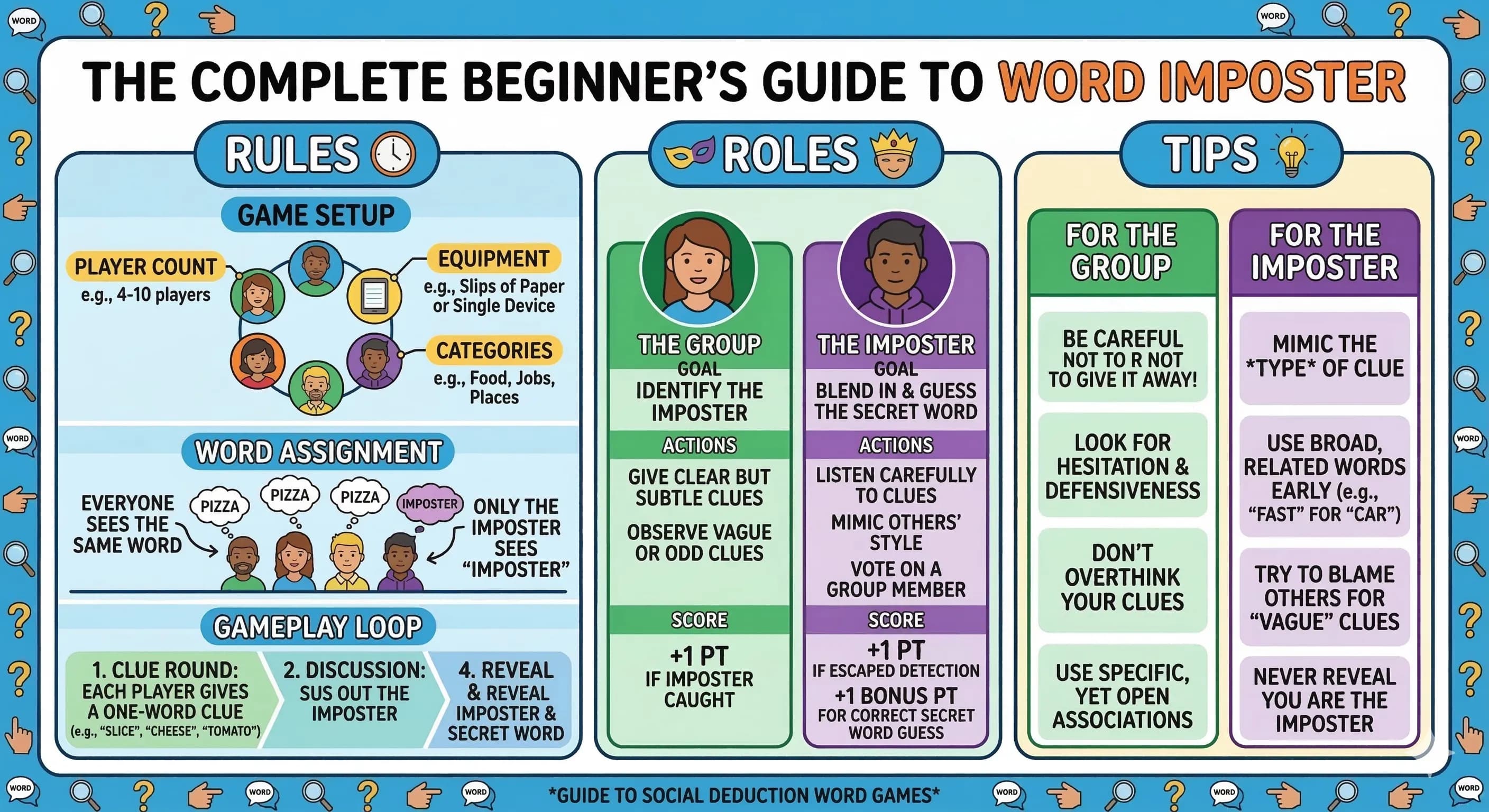

Humans have been designing games around deception for about as long as we've been playing games at all. The specific mechanics change across cultures and centuries, but the core appeal — attempting to deceive others while detecting their deception — is remarkably consistent. Here's a brief history of how we got from ancient trick-taking card games to the browser-based social deduction scene of today.
The Ancient Roots: Trick-Taking and Hidden Information
The earliest known playing cards appeared in Tang Dynasty China around the 9th century, and trick-taking games (where players conceal the cards they hold and bluff about the value of their hands) spread rapidly across Asia and into the Islamic world through the following centuries. By the time European card games emerged in the 14th century, the concept of hidden hands and strategic deception was already deeply embedded in the cultural fabric of games.
Poker — the canonical Western bluffing game — crystallized in the early 19th century American South, drawing on French card game traditions and gradually standardizing into the form we'd recognize today. What distinguished Poker from pure gambling games was its emphasis on reading opponents — the bluff, the tell, the controlled information management across multiple betting rounds. Poker made bluffing a primary mechanic, not a side effect.
Liar's Dice and Physical Deception
Outside of card games, dice-based deception games developed independently in South American and European traditions. Liar's Dice — where players conceal their dice rolls and make escalating claims about the total dice showing a certain number — has a remarkably similar psychological structure to modern social deduction games. Each player has private information. They make public claims. Others decide to believe or challenge. The reveal determines the winner.
This "private information → public claim → verification" loop is the atomic unit of every bluffing game from Liar's Dice to Poker to Word Impostor. The genius of the genre is that this simple loop scales from two players to twenty, and produces different social dynamics at each scale.
The 20th Century: Deception as Party Game
The shift from deception as gambling mechanic to deception as pure social entertainment happened gradually through the 20th century, with a pivotal moment in 1986. Dmitry Davidoff, a psychology student at Moscow State University, invented Mafia as a classroom exercise in studying cognitive biases under social pressure. The game — a group of innocent townspeople trying to identify a hidden criminal faction through discussion and vote — spread virally through word of mouth across universities, summer camps, and social groups worldwide.
Mafia required no materials, scaled to any group size, and produced exactly the kind of spontaneous drama and storytelling that makes games memorable long after they're finished. It expanded into Werewolf, with a village protecting itself from werewolves who secretly attacked each night, and spawned dozens of variants across different cultural contexts.
The Tabletop Renaissance and Hidden Roles
The 2000s and 2010s saw a tabletop gaming renaissance that produced sophisticated social deduction games with dedicated card decks, complex role variants, and refined mechanics. The Resistance (2009) stripped Mafia down to its essentials and added a mission-failure mechanic that created tighter, faster games. One Night Ultimate Werewolf (2014) compressed the entire game into a single elimination-free night phase. Secret Hitler (2016) added hidden allegiances within allegiances.
Spyfall (2014) brought a specific innovation: instead of voting out players, the spy had to survive a round of questioning while not knowing the group's shared secret location. The real-time conversation element — rather than vote-based elimination — was genuinely new to the genre at scale. Word Impostor's relationship to Spyfall is direct and acknowledged; the one-word clue format is a specific distillation of Spyfall's hidden-knowledge mechanic.
Among Us and the Digital Turn
Among Us (2018, viral 2020) is probably the single most important moment in social deduction gaming history in terms of mainstream penetration. By translating the crew-vs-imposters formula into a video game with task mechanics and visual evidence, Among Us made social deduction accessible to audiences who had never played a tabletop game. Its explosion during the pandemic — when millions of social interactions moved online — introduced a completely new generation to the core pleasure of the genre.
The cultural moment Among Us created has sustained enormous interest in browser-based social deduction games. Word Impostor, Town of Salem, and other web-native implementations caught the wave and have grown continuously since.
Word Impostor in Context
Word Impostor sits in a specific evolutionary slot: it takes the hidden-knowledge mechanic from Spyfall, the social accusation structure from Mafia/Werewolf, the accessibility of Among Us, and compresses them into the fastest, most zero-friction format possible. No physical cards, no game master, no download, no purchase. A browser tab and three willing people are all the game has ever needed.
The "In the Dark" mode — where the impostor doesn't know they're the impostor — represents a genuine mechanical innovation in the genre. Confident wrong information versus absent information creates a completely different psychological dynamic that even 40 years of Mafia/Werewolf tradition hadn't quite arrived at.
What's Next for the Genre
The trajectory of social deduction games points toward integration with digital social platforms — experiences that live natively where people already spend time rather than requiring a separate download or physical gathering. Browser-based games like Word Impostor are already there; the question is how much richer the genre can get while maintaining the zero-friction accessibility that made it explode in the first place.
The answer, historically, is: significantly. Each generation of designers has found ways to add depth without adding complexity, and the core appeal — trying to catch someone else in a lie, or successfully lying to a roomful of attentive people — doesn't age. It's been working since Tang Dynasty card tables. It'll work for a while longer.
Want to be part of the tradition? Start a game of Word Impostor. And if you want to know more about what makes the genre tick psychologically, read our piece on the psychology of bluffing games.