

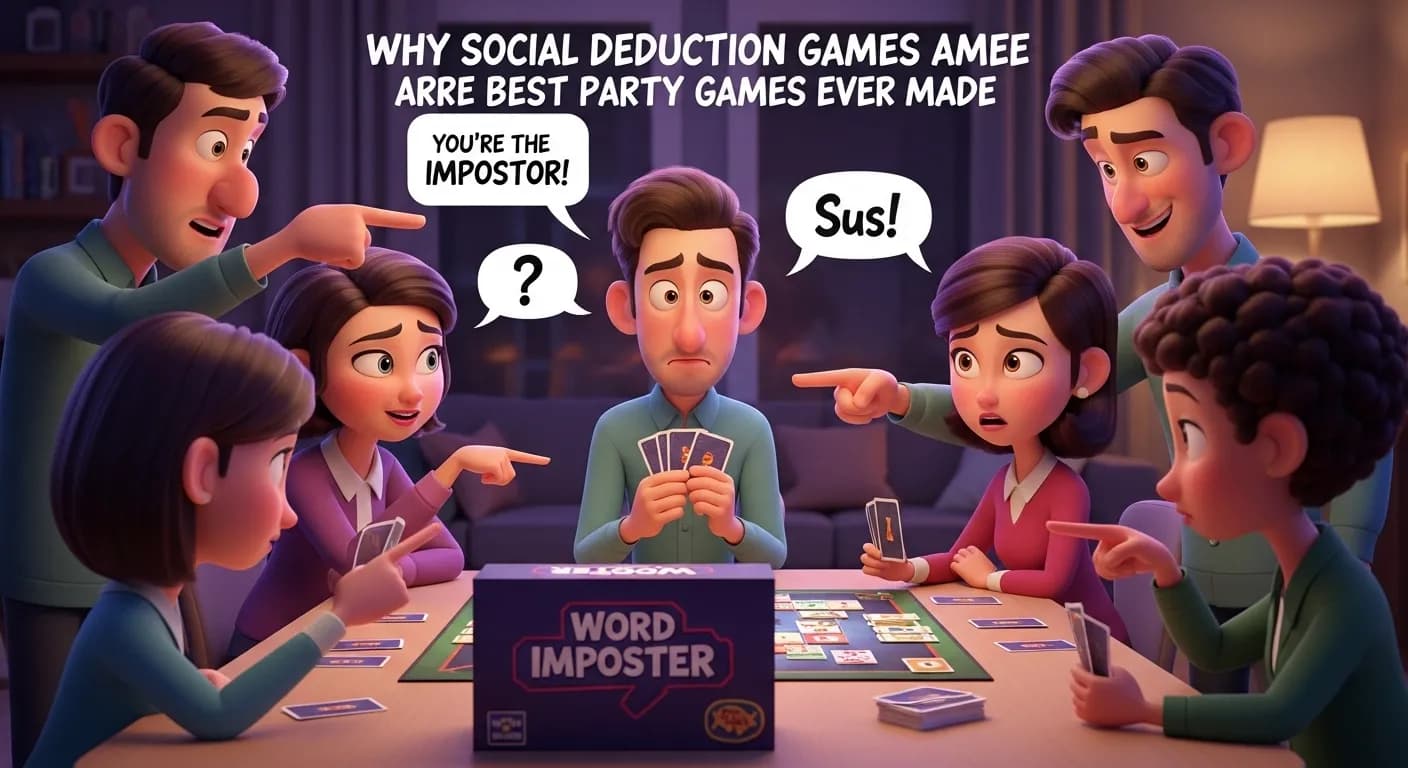

This is an opinion piece. But it's one grounded in design theory, psychology, and a few hundred hours of watching groups of very different people become completely absorbed in the same type of game. Social deduction games are the best party games ever created. Here's the case.
They're the Most Accessible and the Most Deep Simultaneously
Most games force a trade-off between accessibility and depth. Chess is infinitely deep but has a brutal learning curve. Snakes and Ladders is completely accessible but essentially random. Social deduction games somehow avoid this trade-off: the rules fit on a single card and can be explained in under two minutes, but the strategic depth — the behavioral pattern recognition, the clue calibration, the accusation management — can occupy players for years.
The accessibility comes from the rules. The depth comes from other people. And other people are endlessly complex. You'll never fully master Word Impostor or Werewolf because your opponents are always changing — new players, experienced players, players in different moods, players who've read your tells and adapted. The game refreshes itself continuously.
Every Round Creates a Unique Story
Traditional board games produce outcomes — someone won, someone built a bigger empire, someone got the most victory points. Social deduction games produce stories. The moment when the impostor finally broke down under cross-examination. When someone correctly identified the spy with nothing but a feeling and one suspicious word choice. When the "most honest" player in the group turned out to be the impostor for three rounds in a row.
These stories get retold. They become reference material for the group's shared history. Two years later, someone brings up "remember when you said 'lighthouse' and we all IMMEDIATELY knew?" and the whole room collapses. That kind of narrative residue — the thing you're still talking about long after the game is over — is rare and valuable, and social deduction games produce it almost every session.
They Surface Personality in Fascinating Ways
People reveal themselves in social deduction games in ways they rarely do in normal conversation. How someone handles being falsely accused. Whether they tend to panic or go calculating when under pressure. Whether they default to aggression or misdirection when they're the impostor. Whether they're naturally suspicious or too trusting as civilians.
These aren't trivial personality insights. They're often surprisingly accurate windows into how people operate under stress, how they use language strategically, and how they balance self-interest against social dynamics. Partners have reportedly learned things about each other playing Word Impostor that didn't surface in years of normal conversation. That's not a claim most Candy Land games can make.
Everyone Gets the Same Information Budget
Social deduction games are remarkably fair by design. There's no advantage conferred by better reflexes, higher vocabulary, more gaming experience, or bigger game collection. Everyone operates with the same information or information-deficit, and the outcomes are determined entirely by social intelligence and reasoning ability. A 12-year-old with sharp intuition can beat a room full of adults. A first-time player can correctly identify an experienced impostor in round one if they're paying attention.
That equality — the sense that the game respects everyone at the table equally — is one of the key reasons social deduction games work for such diverse groups. There's no "I lost because they were better at the mechanical skill." There's only "I was outplayed socially." Which, honestly, makes the wins feel more earned and the losses feel more instructive.
They Get Better the More You Play
Most party games are flat across multiple sessions — you're having roughly the same experience the tenth time you play as the first. Social deduction games compound. Your tenth Word Impostor session is categorically different from your first because you know the players better, they know you better, and the meta-game of managing your own reputation and tells has developed over time.
Experienced groups develop their own ecosystem — certain players who are always over-trusted, certain tells that specific players can't shake, running strategies that the whole group knows about and has to account for. This layered meta-game gives the genre a replay ceiling that's effectively unlimited.
The Counter-Arguments
To be fair to other genres: competitive board games like Catan or Ticket to Ride have strategic depth that social deduction games can't match. Cooperative games like Pandemic create a different (and genuinely excellent) type of shared experience. Party games like Jackbox or Codenames are more comfortable for people who don't enjoy the specific pressure of being falsely accused or having to bluff in public.
Social deduction games aren't for everyone — specifically, they require a comfort with uncertainty, social observation, and occasionally being singled out. If your group has players who get genuinely uncomfortable being "on trial" even in a game context, ease in with a simpler format first.
The Best Version for Right Now
For groups who want the social deduction experience with the lowest possible barrier to entry, Word Impostor is the answer. It's free, runs in your browser, requires no account, and can be explained in under two minutes. Read our full explainer on the genre if you're new to it, then check our beginner's guide and start a game. The arguments above will start making personal sense from round one.